Dallas junk removal guide
The complete guide to handling an estate cleanout in North Texas
Clearing the home of someone you have lost means paperwork, family decisions and heavy lifting, often all at once. This is the order that keeps what matters safe and still gets the house empty.
8 min read
Quick answer
An estate cleanout empties a home after someone dies: the family takes what it is keeping, valuables are sold, usable things are donated, and a crew removes the rest. In Texas, first confirm who has legal authority over the property, usually an executor or administrator the probate court approves, and secure papers and valuables before anything leaves.
If you are reading this, you have probably just lost someone, and the house has landed on a list that is already too long. Very little of it is urgent. Here is the order of work, whether the family does most of it or hands the heavy part to a crew that clears family homes.
- Settle authority first. Usually an executor or administrator approved by the probate court is in charge of the contents; until then, secure the house and find the paperwork.
- Order beats speed: family, then the sale, then donation, then the haul-away. Reversing it is how keepsakes get lost.
- Volume sets the price. Whatever the family keeps, sells or donates is space you do not pay for; a full truck starts at $699.
Who has authority to clear a probate house in Texas?
In Texas, the person legally in charge of an estate's property is the personal representative: an executor if there is a will, an administrator if there is not. The court has to approve them, and the probate clerk then issues letters testamentary or letters of administration: the document that lets them act for the estate, collect its property and transfer titles.
Some smaller estates use a small estate affidavit instead. It requires no will, an estate worth $75,000 or less (not counting the homestead and exempt property), assets that exceed debts, and at least 30 days since the death, and it can pass the house only to a surviving spouse or minor child. In Dallas County, the clerk's probate division at 600 Commerce St. lists a $360 filing fee.
Which route fits is a question for a probate attorney, and almost every probate case needs one; TexasLawHelp.org's guide to handling an estate in Texas explains the options. Meanwhile, do the work that moves nothing out of the house: secure it, find the paperwork and photograph every room.
A realistic timeline, from the first week to an empty house
No law sets this pace; the court and the family's readiness do. Treat it as a typical sequence, not a schedule.
| Stage | What happens | When it usually fits |
|---|---|---|
| Make the house safe | Lock up, keep utilities and insurance in place, tell the insurer it is empty, and find the will. | The first days |
| Settle authority | An attorney applies for letters, or the heirs prepare a small estate affidavit. | Starts early; the court sets the pace |
| Photograph and appraise | Record every room. Once appointed, an independent executor has 90 days to file a sworn inventory, or an affidavit instead. | Once someone is in charge |
| Family picks | Relatives take keepsakes; anything disputed waits for the executor. | Once authority is clear |
| Sale or auction | A company sells what has value; in Dallas, the sale needs a city permit, which can take 2 to 3 business days to approve. | After the family picks |
| Donate and clear | Charities collect usable goods; a crew removes the rest. | After the sale |
| Hand over | A final walk-through of closets, attic, garage and shed; then utilities and keys. | Before listing photos or closing |
How to clean out a deceased parent's house, room by room
Work from what matters most to what matters least, so nothing is thrown away before someone could want it.
- Keep and distribute. Family members tag or take what they are keeping, one color of tape per person.
- Sell. Furniture, jewelry, tools, art and collectibles go to an estate sale, an auction or a private buyer.
- Donate. Clean, working, complete items go to charity; this guide to furniture donation pickups in Dallas covers what charities accept.
- Recycle. Metal, electronics, cardboard and paper. Shred anything with account or Social Security numbers first.
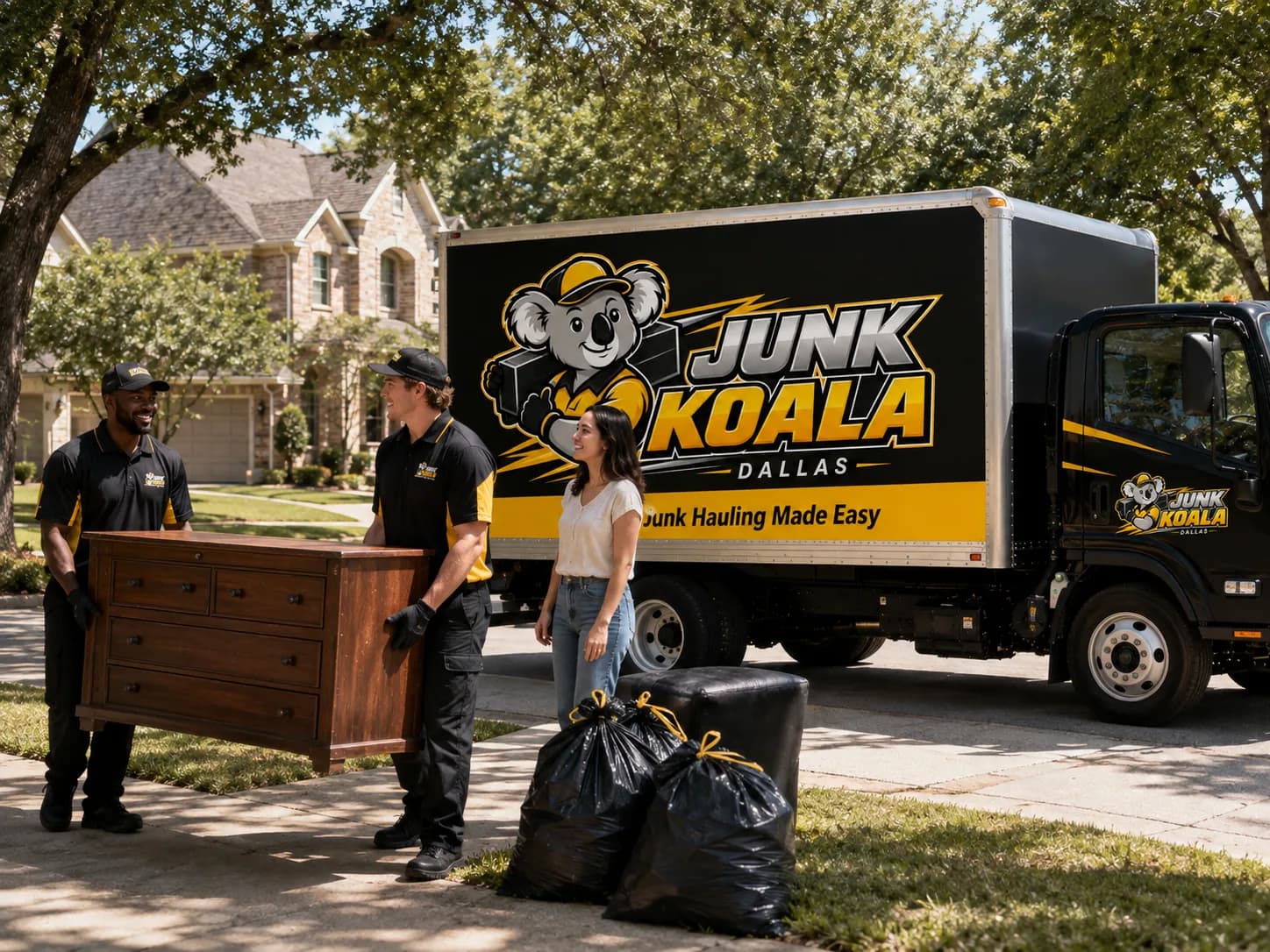
- Discard. Whatever is broken, stained or worn out. Junk Koala Dallas sorts every load as it is loaded: usable items to donation or resale; metal, electronics and cardboard to recycling, with mattresses wherever a facility accepts them; only the rest to landfill.
What to set aside before anything leaves the house
Paperwork and valuables hide in coat pockets, books, freezers and the backs of drawers. Check for these before any bag goes out:
- The will and legal papers. No will at home? Ask the county clerk whether one was deposited for safekeeping; it is rare, but it happens. Keep deeds, titles and policies with it.
- Financial records. Statements, tax returns and unopened mail reveal accounts, and the year's records are needed for the final income tax return.
- Valuables and keepsakes. Jewelry, cash, coins, art, photographs, letters, military papers and medals. Appraise anything uncertain before a sale prices it.
- Safe deposit boxes. In Texas, a spouse, parent, adult child or named executor can search one for a will, burial instructions or a life insurance policy, supervised by the bank.
- Firearms. Leave them for the executor: whoever receives one must be legally allowed to possess it, so any transfer has to follow state and federal law. The Texas State Law Library explains the basics.
- Medications and needles. The FDA's first choice for medicines is a take-back option, such as a pharmacy drop box or a prepaid mail-back envelope; used needles go into a sharps container.
- Rented equipment. A hospital bed or oxygen equipment that was rented goes back to the supplier.
What cannot go on the truck
Paint, solvents, fuel, asbestos and other hazardous materials cannot go on our truck. Residents of Dallas and other member cities can take household chemicals, paint, pool products and batteries to the Dallas County Home Chemical Collection Center at 11234 Plano Rd free, with a driver's license and a utility bill; others pay at least $100. It refuses ammunition, explosives and medical waste. See where hazardous waste goes in Dallas County.
Estate sale vs estate cleanout: do you need one or both?
An estate sale company turns valuables into money; a cleanout crew turns a full house into an empty one. Many family homes need both, in that order.
| Factor | Estate sale company | Cleanout crew | Both, in order |
|---|---|---|---|
| What it does | Prices and sells the contents to the public | Removes what is left, sorted for donation, recycling and disposal | The sale takes the valuables; the crew clears the rest |
| How it is paid | Ask how the fee is calculated and whether it comes from the proceeds | By the volume removed; get the price before work starts | Each is priced separately |
| Best when | There is enough of value to draw buyers | Little resale value, a deadline, or leftovers from a sale | A full home with some valuable pieces |
Unsure whether there is enough to sell? Ask an estate sale company to look first. If there is not, a whole-house clear-out takes everything at once.
See the price before anyone comes out
Send photos or an item list of what is left, and see the price before a crew is dispatched.
What does clearing out an estate cost, and why?
The clear-out is priced by the space the load takes in the truck, not by the hour, so the biggest factor is how much is left. Junk Koala Dallas shows the price online, from photos or an item list, before a crew is dispatched. Starting prices:
- A single item: from $129.
- A minimum load, roughly an eighth of the truck: from $149.
- A quarter of the truck: from $249.
- Half the truck: from $419.
- A full truck: from $699.
More than one truckload is quoted after a walkthrough. Heavy material such as concrete, tile, soil and roofing is priced by weight, and booking online takes up to $20 off jobs above the minimum. The full pricing breakdown compares the load sizes.
Handling it all from out of state
Living outside Texas does not bar you from serving as executor, though the court requires a Texas resident agent to accept legal papers for the estate; your attorney can arrange one. The rest can run remotely:
- Scope it from photos. A neighbor or relative can send wide shots of every room, the garage, attic and shed; Junk Koala Dallas prices from those before anyone is dispatched.
- Arrange access. A lockbox or a local key-holder, such as the listing agent, saves a flight, and the agent can say when the house is ready for listing photos.
- Walk relatives through on video so they can point out what to keep.
- Ask for photos of every finished room before handing over the keys.
A printable checklist for clearing the house
Print this estate cleanout checklist and work down it in order.
- Confirm who has authority, and talk to a probate attorney.
- Secure the house, and tell the insurer it is empty.
- Find the will, deeds, titles, policies and statements.
- Photograph every room before anything moves.
- Remove medications, firearms, cash, jewelry and personal papers.
- Let family tag or take what they are keeping.
- Appraise valuables, then hold the sale, with a city permit in Dallas.
- Book charity pickups for usable furniture and goods.
- Take paint, chemicals and batteries to the county center.
- Book the clear-out for everything that is left.
- Hand over the keys after a final check of closets, attic, garage and shed.
Frequently asked questions
What should I do with a deceased person's belongings nobody wants?
Donate what is clean and usable, recycle metal, electronics and paper, and have the rest hauled away. Charities turn down stained, broken or worn-out items, so those go with the clear-out.
What should I do with a parent's leftover prescriptions?
Take them to a drug take-back location, such as a pharmacy drop box or a DEA take-back event. If neither is practical, the FDA explains how to dispose of most medicines at home; after hospice care, ask the hospice team first.
What should happen to firearms found in a parent's house?
They go to the executor, not out with the clear-out. Whoever inherits a firearm must be legally allowed to possess it, so any transfer has to follow state and federal law.
Will homeowner's insurance cover the house while it sits empty?
Not indefinitely. The Texas Department of Insurance says most companies stop coverage once a house has been vacant for 60 days, though liability coverage usually continues; tell the insurer the house is empty.
Can I forward a deceased parent's mail to my address?
Yes, if you are the appointed executor or administrator. USPS requires an in-person change of address at a Post Office, with documents proving that authority; a death certificate alone is not enough.
How soon after a death can a small estate affidavit be filed?
Not until 30 days have passed. It also requires no will and an estate worth $75,000 or less, not counting the homestead and exempt property; in Dallas County the clerk lists a $360 filing fee.
Sources
- TexasLawHelp.org: Probate Court Basics
- TexasLawHelp.org: Small Estate Affidavits
- TexasLawHelp.org: Transferring the Deceased's Property Without Going to Court
- TexasLawHelp.org: Handling an Estate
- TexasLawHelp.org: Estate Administration in Texas
- Dallas County Clerk, Probate Courts Division: Know Before You Come
- Texas State Law Library: Before Probate
- Texas State Law Library: Inheriting Firearms
- City of Dallas Code Compliance: Garage sale permits
- Texas Department of Insurance: Home insurance guide
- USPS: How to stop or forward mail for the deceased
- IRS: File the final income tax returns of a deceased person
- FDA: Drug take-back options
- FDA: Disposing of medicines in household trash
- FDA: Drug disposal questions and answers
- FDA: Best way to get rid of used needles and other sharps
- Dallas County Home Chemical Collection Center
- Dallas County: What to bring to the Home Chemical Collection Center
Rules, addresses and fees above were checked against these sources on . Cities change their rules; the linked page is the final word.
Written by the Junk Koala Dallas team. Serving Dallas, Garland, Mesquite, Richardson, Addison and Farmers Branch.
All articlesNext steps
Where to go from here
Ready when you are
When the family is ready, the rest can go
Send photos of what is left after the keepsakes and the sale, and see the price before anyone is dispatched. Usable pieces are sorted for donation or resale as the truck is loaded.
Or call(214) 234-3063